juce::ScreenSaverDefeater Class Reference
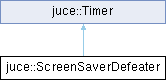
Inheritance diagram for juce::ScreenSaverDefeater:
Public Member Functions | |
| ScreenSaverDefeater () | |
| void | timerCallback () override |
| Public Member Functions inherited from juce::Timer | |
| virtual | ~Timer () |
| void | startTimer (int intervalInMilliseconds) noexcept |
| void | startTimerHz (int timerFrequencyHz) noexcept |
| void | stopTimer () noexcept |
| bool | isTimerRunning () const noexcept |
| int | getTimerInterval () const noexcept |
Additional Inherited Members | |
| Static Public Member Functions inherited from juce::Timer | |
| static void JUCE_CALLTYPE | callAfterDelay (int milliseconds, std::function< void()> functionToCall) |
| static void JUCE_CALLTYPE | callPendingTimersSynchronously () |
| Protected Member Functions inherited from juce::Timer | |
| Timer () noexcept | |
| Timer (const Timer &) noexcept | |
Constructor & Destructor Documentation
◆ ScreenSaverDefeater()
|
inline |
Member Function Documentation
◆ timerCallback()
|
inlineoverridevirtual |
The user-defined callback routine that actually gets called periodically.
It's perfectly ok to call startTimer() or stopTimer() from within this callback to change the subsequent intervals.
Implements juce::Timer.
The documentation for this class was generated from the following file:
- /home/runner/work/lmms/lmms/plugins/CarlaBase/carla/source/modules/juce_gui_basics/native/juce_win32_Windowing.cpp
Generated on for LMMS by
 1.16.1